How to solve a Sudokube

Hello!

You have probably found this page because you have a "Sudokube" and want to solve it, or you just want to know what a "Sudokube" is.

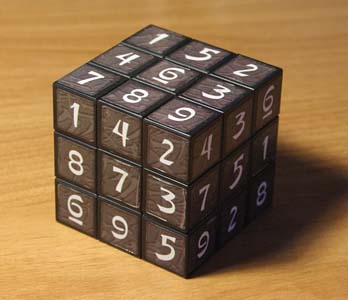
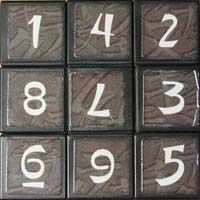
The "Sudokube" or "Sudoku Cube" or "Sudoku Kube" is a Rubik's Cube that has numbered stickers on it instead of coloured stickers. The object of the puzzle is to arrange the cube in such a way that each cube face shows the digits 1 to 9 with no duplicate digits, similar to what you might see in a 3x3 block of the popular Sudoku puzzles. The digits do not necessarily have to be in order, depending on what kind of Sudokube you have.

Solved Sudokube:

Before you start trying to solve a Sudokube, you should familiarize yourself with how to solve a standard Rubik's Cube. I learned the Lars Petrus method, which is quite an easy method for beginners to learn. Once you have your Rubik's Cube skills down pat, you should understand the basics of how individual cubies move around and interact with each other. At this point you should be able to figure out the secrets of the Sudokube, but in case you are still having trouble, read on.

The solution

The first thing you should realize is that once the cube is solved, all of the numbers on a given side will have the same orientation (except possibly for the one in the center -- we will get to that later). Using this information, you should be able to easily figure out where all the corners should be relative to each other.

The second thing you should realize is that the centers of each face are fixed relative to each other. This is the first thing you learn about basic Rubik's Cube solving.

Using these two pieces of information, you might be able to already figure out where all of the corners go relative to the centers. If you can, that's great! All we need to do is figure out where the 12 edge pieces go. If the corners are still ambiguous, we will have to do more analysis involving the edge pieces.
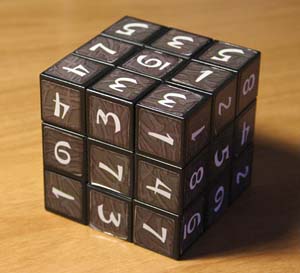
Unsolved Sudokube:

On my Sudokube, the eight corner pieces are labelled "771", "294", "595", "464", "629", "853", "113", and "687". You can see some of the corners and their orientations in the photos above and below. The six center pieces are "1", "7", "5", "4", "6", and another "1". Based on the orientation and the numbers I worked out that the only possible configuration of the cube is as follows:

     1   2						
       6							
     7   9						
3   71   24   69   1
  1    7    5    4	
8   46   59   85   6
     4   5						
       1				
     7   3						
(Sorry for the ASCII graphics... this is basically an "unfolded" cube with the centers and corners labelled.) Note that this is all theoretical. There is no need to actually put the cube into this configuration, unless you want to visually convince yourself that it is correct.

OK, the edge pieces. For these guys we will use a combination of sticker orientation and Sudoku techniques to figure out where they go. First, let us label all of the different possible sticker orientations on the cube:

     1 e 2						
     d 6 c							
     7 b 9						
3 d 71 b 24 c 69 e 1
a 1 aa 7 aa 5 aa 4 a	
8 g 46 f 59 h 85 b 6
     4 f 5						
     g 1 h			
     7 b 3						
On my cube there are eight possible orientation combinations for the edge pieces. I have labelled them "aa" to "hh". I then made a list of all the edges that had matching orientations: As you can see, there is only one possible location for six of the twelve edge pieces! That makes things much easier. For the "aa" and "bb" edges, you must call on your Sudoku skills to figure out where they go!

In my case, the final solution looked like this:
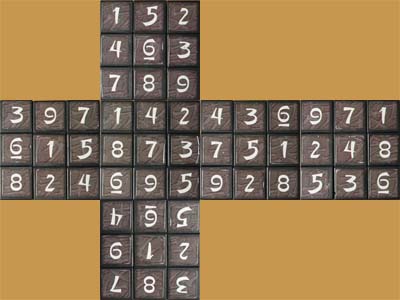
"Unfolded" Sudokube:
     1 5 2						
     4 6 3							
     7 8 9						
3 9 71 4 24 3 69 7 1
6 1 58 7 37 5 12 4 8	
8 2 46 9 59 2 85 3 6
     4 6 5						
     9 1 2			
     7 8 3						

Once you have figured out where everything should go, you can use your standard Rubik's Cube skills to put it all into place. The only difficulty at this point is staying focussed and keeping track of what you have already solved, since it's not obvious at first glance!
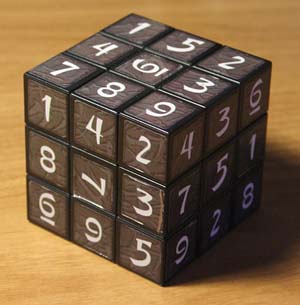
Twisting the centers

Once you have the cube "solved", you may notice that some or all of your center pieces are twisted! There are a few useful moves for fixing these up and making your cube look like new again.
Sudokube with two twisted centers:
Sudokube with one twisted center:

There we go! I hope you found this useful!

Comments


Note: This comment form is not to be used for advertising. By clicking the "Add Comment" button below, you agree to the following terms: If the maintainer of this website deems your comment to contain an advertisement, you agree that the owners of the site being advertised will be charged $1.00 USD for every minute that your advertisement appears on this website.

Comments

YOU ARE A STUPID IDIOT!!

The sudokube came with all of the fiives in the center.. as you can see, you
have taken off the stickers, and moved them around to appear solved. Also,
there is no way that a 7 or a 6 can be in the center of the square on one side.

Also the cube comes in numerical order, for instance on one side it should
read:
123
456
789

I have nothing more to say.
-- MIchael at 4:12pm, Thursday March 22, 2007 EST

Thanks for your comment, but unfortunately it is your ignorance that is
showing.  Sudokubes can be manufactured in various ways.  Some of them have the
digits in order on each of the faces when they are solved.  It is easy to find
out if this is the case by looking at the centers and noticing that they are
all 5's, as you have so kindly pointed out.

In my instructions above, I specifically mentioned that not all Sudokubes have
the same solution.  I apologize if I wasn't clear enough.  By modifying my
solution above, you should be able to figure out how to solve your specific
Sudokube.

Thanks for visiting my site!
-- Michael (the author) at 4:53pm, Thursday March 22, 2007 EST

there is a site (http://www.wrongway.org/cube/solve.html) that you put your
rubiks cube stuff in and it will tell you the moves to complete it.

maybe you or you and someone could make a sudokube one
-- SuperNerd at 4:37am, Monday April 9, 2007 EST

Thanks!  That is a cool site, and the source code is available too... adapting
it to solve Sudokubes would be an interesting problem!
-- Michael at 10:16am, Monday April 9, 2007 EST

Thank you so much for you great great help. I don't actually have a Sudokube
but I have one that each side have a picture. I did it as if it is a regular
cube and I get everything in the right place and orientations except for the
centres and I had a hard time to trying to figure out what to do. Finally, I
found out this kind of cube which is the same as mine that need the right
orientations of the centres.

Thanks a lot
-- ML at 12:47am, Tuesday April 10, 2007 EST

Umm that guy who made the first post...i have a sudokube exactly like the
person who made this faq (btw nice faq, sorta still confuses me a bit =]) and
well, all my centre pieces arent "5"'s theyre: 1, 1, 7, 4, 5, 6. and my design
is exactly the same, with all the katakana images...so please, dont abuse other
people's faqs, unless its something really bold, and out-standing.
THANKS FOR THE FAQ! Its really good.
-- Shadow mario at 4:44am, Sunday April 15, 2007 EST

I really found the last algorithum to be very usfull! Although you have a
different cube than mine. All of my centers are fives. How do you get the
bottom cross on these things?
-- Audrey at 2:53pm, Tuesday May 8, 2007 EST

hey michael
thank you so much for this site, i have the same exact cube and i would be lost
without you. The only thing left i have to do now is rotate the center pieces.
I solved it once before but when i went to use the algorithms provided to solve
the centers, my whole cube was messed up. Are you sure your algorithms are
correct? Thanks again for the FAQ!
-- Jeremy at 8:55am, Sunday June 10, 2007 EST

Hi Jeremy,

Glad you are enjoying it.  I just double checked my centre twisting algorithms,
and they are correct.  The first one can definitely get confusing though with
all of the different clockwise and counterclockwise turns.  You really have to
think about each step to make sure you are turning the correct face in the
correct direction.

Just a reminder about terminology:

u = "up" face (the one on the top)
d = "down" face (the one on the bottom)
f = "front" face (the one facing you)
b = "back" face (the one facing away from you)
l = "left" face (the face on the left)
r = "right" face (the face on the right)

A single letter means turn the face clockwise, and a single letter with an
apostrophe means turn the face counter-clockwise.  A double letter means turn
that face 180 degrees (direction doesn't matter).
-- Michael at 12:19pm, Sunday June 10, 2007 EST

ok, i did it another time and it worked =]. thanks it was probably just
laziness that messed me up.
-- Jeremy at 3:37pm, Sunday June 10, 2007 EST

Great!	Glad to hear it worked out.
-- Michael at 4:06pm, Sunday June 10, 2007 EST

Hi, I got this exact cube today and after looking it over started wondering
whether about the solution and wanted to see what a solved kube looked like and
was surprised to see your solution.  Shouldn't a "true" sudokube have solution
numbers that run both vertically and horizontally like the paper version?  Your
first photo shows two 2s in the right face, two 7s in the front face, two 1s on
the back face and two 3s in the middle.  Is it mathematically impossible to
make one that acts like the paper version?  Thanks!

P.S. The 1st guy was a jerk.  You page rocks!
-- Cheri at 12:58am, Thursday June 14, 2007 EST

Hi Cheri, I'm glad you like the page.

You are confusing me with your terminology, but I think I understand what you
are saying.  If you look at my "Unfolded Sudokube" picture, you can see the
problem with trying to have each number appear only once in each row or column
of the kube.  There are only 9 numbers, but there are 12 entries in each row or
column (going all the way around the kube).  So, some numbers have to be
repeated.  QED.

Does that answer your question?
-- Michael at 10:27am, Thursday June 14, 2007 EST

Thanks for the tip on rotating the center pieces. I took a lot more time than I
do on a regular cube making sure that I had my center pieces on the sides were
aligned correctly all along, and then managed to have the center piece on my
bottom face backwards after solving it. Whoops.
-- Irish at 7:49am, Wednesday June 20, 2007 EST

I have a Sudokube where all of the center points are 5. Where would i find
algorithms for that cube
-- Harrison at 11:18am, Sunday July 8, 2007 EST

you are the bomb.  I have had this stupid thing since December and been trying
every possible solution to solve it.  Now that I found someone with the same
type of cube, and a quick layout its easy to solve.  I got papers galor with
that  +- design I have been trying every possible solution with my numbers. 
Sadly for the first poster,  I think the middles being all 5s would make the
cube too easy.
-- Joe at 10:49am, Wednesday July 11, 2007 EST

the UC/FC rotation moves aren't right. what works for me is the opposite
rotations, essentially all your moves with a different direction for last U
slice:

UC CCW (left 90)/FC CW (right 90)
F B' L R' U D' F U' D L' R F' B U'
-- bobh at 12:31pm, Saturday August 29, 2009 EST

My moves are correct.  Mine rotate the UC CW and the FC CCW, and yours go the
opposite direction, but both of them work.  Thanks for the input!
-- Michael at 12:24pm, Sunday August 30, 2009 EST

ahhh...I see what I did.  I consistently misread the middle F' in your sequence
as a plain F.  It led to a different orientation in the end, naturally.  All
for the better, though; now we have a means for rotating the UC/FC centers
either direction.
-- bobh at 6:07pm, Monday August 31, 2009 EST

i dunno how can i solve my cube...
it make me confuse..
my center start it with 5..
can u show me the step of it????/
-- miss Q at 12:19pm, Thursday October 1, 2009 EST

no it was no help sorry.
-- bree at 12:19am, Saturday October 31, 2009 EST

isnt the completed cube supposed to run like 123 or even 123 on all sides?
					     456	 654
					     789	 789
other wise its complete when you open the box?
-- hami at 5:22pm, Wednesday November 18, 2009 EST

It depends on the kind of Sudokube that you buy.  For example, the guy who
wrote the first comment bought a Sudokube similar to the one you describe.  My
response to him is below his comment.
-- Michael at 5:26pm, Wednesday November 18, 2009 EST

Yes I bet it works NOT!
-- Chloe at 3:12pm, Sunday December 6, 2009 EST

1 it doesen't work because u haven't showed the right side u faker
-- at 3:17pm, Sunday December 6, 2009 EST

could you help me please 
my centers are 1,1,4,5,6,7

my corners are 6,8,4	5,8,7	1,7,9	4,5,6	1,6,9	2,2,4	3,5,9	1,3,7

the edges are  2,8  6,2  9,2  8,6  7,3	7,4  3,9  5,8  8,9  3,5  1,2  3,4
-- martyn at 3:24pm, Friday December 25, 2009 EST

Sorry dude, I can't help you unless I had the cube in my hands, plus a few free
hours to work it out.  Besides, the whole fun of a puzzle is solving it
yourself!  Using the techniques outlined on this page, you should be able to
crunch the numbers and work out the solution.  It won't be easy, but after you
are done you will have a great feeling of accomplishment.  Merry Christmas!
-- Michael at 11:27am, Saturday December 26, 2009 EST

i acnt understand
-- at 11:42pm, Saturday December 26, 2009 EST

My cube had a different arrangement of numbers to yours and I played around
with it before writing down the original sequence.... But following your logic
I mapped out the corners, edges and fitted the centres to match and drew out
the six faces and using standard moves have so far succeeded in getting two
complete layers correct. The remaining layer centre number was reversed, but
your instructions have corrected that. Tomorrow I will attempt the final layer.
Thank you very much for a splendid set of instructions which certainly work!
-- Alec at 8:11pm, Wednesday December 30, 2009 EST

following on from my post above I solved the final layer OK after using your
instructions. An interesting fact is that although the face number layouts are
the same in my cube to yours, each face of nine numbers is in a completely
different order. The pictures on amazon also show the same solved face numbers
but on different faces to my solved cube. Thus I would guess that the
manufacture has the 9 side number stickers on one press, but each set of face
numbers can be stuck to different arrangement of faces of the final cube.
However we now know the numbers that go with the centre numbers of 5, 7, 4 and
6 !!! If I had known that before I started it would have saved some work!
Thanks again for your instructions, without them I doubt I could have done it.
-- Alec at 3:00pm, Thursday December 31, 2009 EST

my cube is like yours in that the center numbers are the same ... however their
orientations are different
   6
1  7  4  1
   5

can u help me solve it or show me a correct configuration?
its really bugging me
thx
-- Josh at 12:27am, Thursday March 25, 2010 EST

Without having the cube in my hands, it would be quite difficult to solve it
for you.  Besides, the whole point of the puzzle is to solve it yourself! 
Using the techniques outlined on this page, you should be able to do it with a
bit of effort.	Sorry, but good luck!
-- Michael at 8:49am, Thursday March 25, 2010 EST

Hi. 

Just a quick question: I can't seem to find any place on the net, showing how
many different configurations the sudokube has.

I suck a math, so I won't go into numbers as I do not understand them, but it
seems to me that the Sudokube is harder to solve, than the Rubiks cube, at
least if you set standards for solving, like: 

Numbers must face the right way
Numbers must not be upside down
Numbers must be in the right order from 1 to 9

I don't even know if that is possible, but my question to you is: 
Do you know if the Sudokube is harder (more configurations) than the Rubiks
Cube? Do you have any knowlagde of actual numbers to illustrate the differences
in complexity in the two cubes?

Is it plausible that a human would be able to solve the cube within the rules I
listed before, namely no upside-downs, no facing the wrong way (which I guess
is the same thing), and in numerical order from 1 to 9 on all 6 sides?


Other than that, I admire your work and ability to make sense out of it. I am
myself complete and utterly blind to logical problems like these.  
-- Sudo(re)Tard at 10:43am, Friday March 26, 2010 EST

Well, I do have a degree in Pure Mathematics, so I guess you could say that I
have a knowledge of "actual numbers".  :)

The first step that any good mathematician would do to answer your question is
to first determine if anyone else has ever answered the question before.

And they have!	See 

http://en.wikipedia.org/wiki/Rubik%27s_Cube#Mathematics


The only difference between a Sudokube and the Rubik's cube in terms of
configurations is that orientation matters on the centres of the faces of a
Sudokube, according to your rules.  Note that the orientations of the other
numbers are always the same when the cube is solved, due to the cubies being
solid objects.	So there are more combinations possible with a Sudokube.

Here is the relevant quote from Wikipedia:
"Thus there are 46/2 = 2,048 possible configurations of the centre squares in
the otherwise unscrambled position, increasing the total number of possible
Cube permutations from 43,252,003,274,489,856,000 (4.3×10^19) to
88,580,102,706,155,225,088,000 (8.9×10^22)."

Since those numbers are so huge that they boggle the feeble human mind, it
might be easier just to tell your friends that the Sudokube is two thousand
times more complicated than the Rubik's cube.  ;)
-- Michael at 11:02am, Friday March 26, 2010 EST

Thanks a lot! I got an easy cube with all centres as 5s, but I got stuck on the
last step, fixing the centres.
Yay! 2 new algorithms to learn
-- Hugh at 5:12pm, Saturday May 1, 2010 EST

what!!!!!
-- at 4:31pm, Tuesday July 27, 2010 EST

Great site!
I got one of these at a yard sale yesterday, it was a bugger to solve but I got
it.  The hardest part is just keeping track of things during the sequences, you
don't have the colors as a guide to where you are and the orientation of the
cube.  Mine had all 5's in the centers, I can see it would have been much
harder if it was like yours.  One tricky feature of the 5's cube though is it
has several identical cubies, four 6-4 edge pieces for example, if two are
interchanged you cannot finish the puzzle.

I just took care to put the 5's in the right orientations as I went, it is
quite easy to do this at the beginning, and they stay put during the solving
(at least they do with my solving method).

My real question is, what if you allow rotated numbers on each face, how many
solutions could there be?  On my cube for example, you can arrange the center
slice to have '258' on all sides, just rotate this and you still have 1 to 9 on
all faces but on some sides the 2, 5, and 8 are upside down.  On your cube you
could rotate the 2-2 and 3-3 pieces.  But these are relatively trivial cases. 
Is it possible to find other solutions?
-- PaulC at 12:29pm, Sunday August 29, 2010 EST

Wow, thanks for the question.  At first glance, I think the only possible other
solutions are the "trivial" ones that you mention.  I can't find any others. 
I've only thought about it for a minute or so though.  I don't have a rigorous
proof of the nonexistance of other solutions yet.  :)
-- Michael at 9:17pm, Monday August 30, 2010 EST

Hey Michael, 

I have been doing a Rubik's cube for about 6 months, I'm 24 so found it
reasonably easy to get the hang of. Someone in work, just gave me a sudokube
today, and I guaranteed that I would master this thing by the morning..... I am
pretty good a Sudoku, and after reading the initial few paragraphs, thought it
would be easy, and started seeing which corner cubes may be in the correct
position by rotating the top layer and seeing which numbers on corner pieces
were orientated the right way, then after doing the first 4, which melted my
mind, i rotated the right and left faces 180 degrees, and started again, but
realized the centre pieces rotate.... and so... as it's not actually sudoku, I
just can't fathom any process that could fix this!
-- Tommo at 1:48pm, Wednesday October 6, 2010 EST

Yes, the centre pieces rotate... you don't notice it on a regular cube because
orientation doesn't matter.  Once you get the cube "solved" (i.e. everything in
the right place), you can fix the centre rotations using the two algorithms I
mention at the end of my article.  Good luck!
-- Michael at 2:05pm, Wednesday October 6, 2010 EST

I have the same cube and disagree that there is only one possible configuration
of the corners with the centre pieces, there are actually 3 possible
configurations

     1	 2						
       5							
     7	 9						
3   71	 24   69   1
  6    7    1	 4 
8   46	 59   85   6
     4	 5						
       1				
     7	 3	


     1	 2						
       6							
     7	 9						
3   71	 24   69   1
  5    4    1	 7 
8   46	 59   85   6
     4	 5						
       1				
     7	 3	


     1	 2						
       6							
     7	 9						
3   71	 24   69   1
  1    7    5	 4 
8   46	 59   85   6
     4	 5						
       1				
     7	 3					
-- Barry at 7:57pm, Friday November 19, 2010 EST

Hi Barry, it looks like you are correct.  I can't believe I didn't notice that
before.  Are there solutions for those configurations?	When I have time I will
try them on my Sudokube.  Thanks!
-- Michael at 7:48pm, Saturday November 20, 2010 EST

Thank you for your help.  Before, I was using a different method to rotate the
centers, but it was doing too many at once, making it difficult to use.
-- Anonymous at 6:28am, Thursday January 27, 2011 EST

it's true, not all sudoku cubes are the same, if you go on the virtualcube
website it shows the standard notation which is the one michael is using as
well as myself, the one thing wrong on here is the diagram depicting the cube
as a sideways cross (unfolded) the side with the 6 in the center would be
better depicted on the bottom and oriented, i was able to solve it bc i took
pictures of the solved cube before i ever scrambled it
-- Ben at 12:02pm, Wednesday March 9, 2011 EST

Hi. I'm just starting, and I have a question.  How when you are first
visualizing your cubes layout, do you decide which orientation the faces go in?
You chose to have the seven face, faceup and every face to its right, face up,
and the face above it, face up, and the face below it, face down. Determining
this orientation seems important, in order to find the right corners (or is it
not?) How did you decide on the orientation? Or am I wrong in assuming this is
important?
-- Girish at 12:30am, Saturday April 23, 2011 EST

It is not important at the beginning.  Start with the corner pieces, and you
will see how the orientation kind of falls into place.
-- Michael at 11:01am, Saturday April 23, 2011 EST

Hi, Awesome site, Had the same cube, but took the challenge to arrange it
myself, just needed the tiny info of all the numbers being orientated the same
direction. Thanks!
-- Jerom at 6:28pm, Wednesday June 8, 2011 EST

Thank you
this page was really helpfull to make a pattern with my 4x4 cube
-- at 3:59pm, Wednesday August 3, 2011 EST

Im finding this just a tad impossible!

I guess it doesnt help that i can only do the normal rubix cube one way.
And given I have to do each of the corners on the sudoku cube first (as per
your instructions which isnt how i do the rubiks cube) I find myself going
round in circles.
-- Rob at 4:49pm, Monday September 12, 2011 EST

Note that you don't actually have to solve the corners first.  That is just a
technique to figure out where all of the pieces go.  Once you know where all of
the pieces go, you can solve it just like a regular cube.
-- Michael at 4:56pm, Monday September 12, 2011 EST

Hi Michael! I have actually completed the cube, barring the centres. I found
the alogarithm for 2 wrong centres fine, but I have one incorrect centre. The
alogarithm for the 180 degrees rotation doesn't fix it, as it is actually 90
degrees out. Any help please?
-- lancemale@gmail.com at 8:12pm, Monday March 5, 2012 EST

Hello Michael, Just a further word that may help some people. The way that I
solved the cube to get all sides in 1-9 sequence, was to get a normal cube, and
place stickers 1-9 on every side. It was then easy. Good luck!
-- Lance at 3:40am, Tuesday March 6, 2012 EST

Home - Feedback

Hosted by theorem.ca